
Does anyone have a reading list anymore?
I’m completely mystified, these days, how much the daily ritual of reading has withered away, much like the daily newspaper–replaced by a bottomless supply of podcasters, streaming services, and social media memes!
Washington Post columnist George F. Will once said, there used to be a patron nursing his beer in the corner of the bar, railing about his team’s deplorable pitching staff, the high cost of gas at the pump, worthless politicians, etc. “That person,” Will said, “has been replaced by bloggers.”
Only now, the patron has been replaced by podcasters.
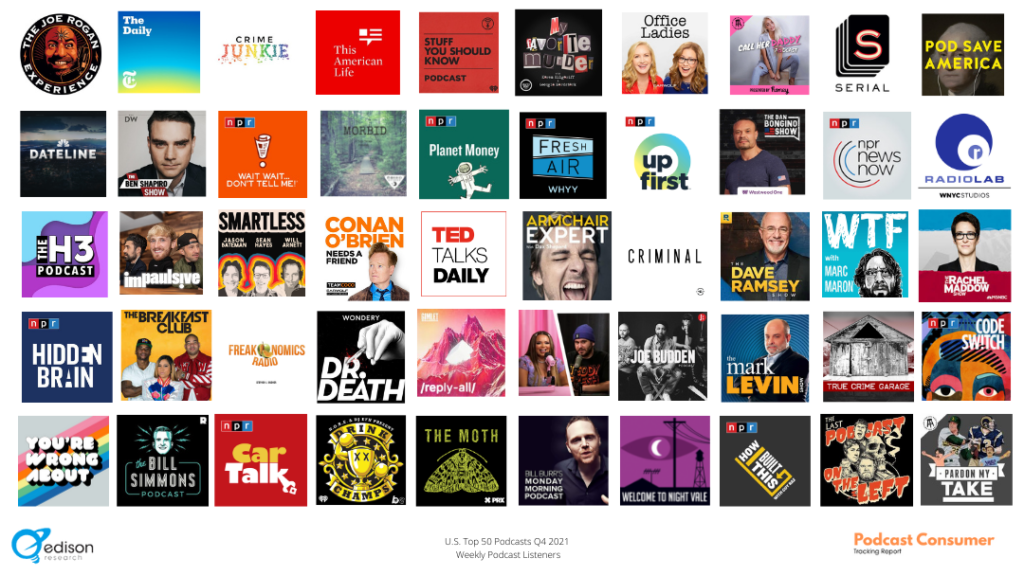
Podcasts or “podcasting” (a term coined by British journalist, Ben Hammersley, in 2004), more than any other medium, these days, is practically coming out of the woodwork. It doesn’t matter what the subject is: hard news, politics, sports, entertainment, comedy, pop psychology forums, and others; whatever your interest–chances are—there’s a podcast ready for you to fire up.
How big is the market for podcasts?
Spotify, the Swedish freemium music streaming service, reports over 7 million podcast shows are available across more than 180 markets, up from about 200,000 titles in early 2019.
That’s a lot of podcasts!
According to Edison Research at SSRS, about 18% of Americans age 13 and older—roughly 50 million people, depending on the population estimate used, listen to podcasts on any typical day.
Edison Research additionally notes that the average total podcast consumption is 5 hours 11 minutes per day—a figure that includes audio and video podcasts. That is, about one in five Americans listen to podcasts on a given day, while more than half listen at least monthly.
As podcasts are on the rise—the ritual of daily reading has plunged to historic lows.
The Los Angeles Times reports that, based on a study from the University of Florida and University College London, the share of people who read for pleasure on a typical day declined from about 28% at its 2004 peak to 16% in 2023—a drop of roughly 43%.
What puzzles me the most is the quality of information the consumer is getting from podcasts compared with reading a book, especially one that received rave reviews, or a sharply written, well-developed, article with reliable and trustworthy sources.
From some, certainly not all, of the podcasts I’ve listened to, podcast hosts are simply shooting from the hip, and making outrageous (if entertaining) comments about subjects they have modest knowledge of. The best part of the podcasts, for these hosts, is that there isn’t any time for any fact-checking—they can just swing for the fences—with little fear of push back. Just as long as it’s entertaining for the consumer.
Time reported that students, who heard a lesson as a podcast, scored 28% lower on average on a later comprehension quiz than students who read the identical lesson on paper.
Everywhere you turn these days, there are screaming headlines on news and magazine sites, from educators and journalists alike– concerned about the rapid decline of reading, including the desertion of simply picking up a book.
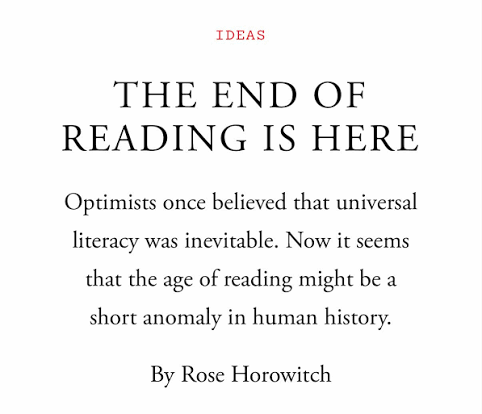
Rose Horowitch, staff writer at The Atlantic, wrote a marvelous piece: “The End of Reading is Here” in which she chronicles how our changing culture, including the infusion of streaming services, and how we spend our leisure time, has been transformed at lightning speed.
Horowitch reports that gambling, for example, has become a more common leisure activity than reading a book: “Last year, 57 percent of Americans placed a bet.”
Horowitch also underscores the extent to which literacy rates have come crashing down.
In 2024, in a national test, The Atlantic reports that “just 35 percent of high-school seniors were “proficient” at skills such as analyzing complex fictional themes and evaluating the effectiveness of an author’s argument.”
Whenever a serious discussion about the erosion of reading arises, all roads lead to the vast array online digital tools, including the explosion of daily social media use; this along with the smorgasbord of streaming services. All of these outlets have dramatically eclipsed treks to your local public library or reading for pleasure and unless it’s part of your homework assignment.
School educators frequently point out that many of these social media platforms, generate instant gratification for the user through “likes” or “retweets,” while reading requires concerted effort first and gratification later in the learning process.
By the time an individual is in middle school, researchers argue, kids are spending several hours a day on social media. Any reading they do is through disjointed posts, texts, captions, and headlines–not through understanding the prudence and moral codes of life through a well written novel.
Another major issue is how the social landscape and rhythms of daily life, for many individuals, have been so sharply transformed.
With so many working multiple jobs and multi-tasking other aspects of their daily routine, they are often exhausted at the end of the day. Reading, for many, takes too much energy; alternatively, watching something on Netflix or Amazon Prime brings immediate relaxation and indulgence.
And when children, in particular, regularly observe their parents streaming shows all evening and rarely reading, they come away with the impression that reading isn’t a leisure activity, but something reserved either for school or when studying for a test.
The American Academy of Arts and Sciences, (based on the National Education Association data), reports that the share of adults who read at least one book for pleasure in the previous year fell from 61% in 1992 to 48.5% in 2022, representing a historic low.
What’s more, a 2023 National Assessment of Educational Progress report reveal only 14% of 13‑year‑olds read for enjoyment “nearly every day,” the lowest share since the federal government began tracking that behavior in 1984.
Jonathan Rose, professor of History at Drew University (Madison, N.J.) contends our public schools, especially in the inner cities, are “disgracefully failing to teach basic literacy. “
School analytic data corroborates Professor’s Rose’s harsh assessment.
In 2024, the National Assessment of Educational Progress (NAEP) reading assessment, reports that 32% of U.S. twelfth-graders scored below NAEP Basic, the highest proportion recorded for that grade-level reading assessment. The national average grade-12 reading score was also 3 points lower than in 2019, while 35% performed at or above NAEP Proficient.
Other analytic data also reveals that the most alarming decline in reading for pleasure shows up among Black Americans and people with lower income, less education, or weaker access to nearby libraries and bookstores.
Results from an American Time Use Survey (ATUS) study, published in the journal iScience, indicates that Black adults who read for pleasure peaked in 2004, at about 20%. But by 2023, that figure had dropped to just 9%. The data means that Black respondents had a 49% lower prevalence of daily leisure reading than white respondents in 2023.
There are a number of compelling reasons for such low levels of reading comprehension among Black Americans; but a predominant reason, often cited, is that when children don’t have easy access to public libraries or bookstores, including lack of transportation–reading becomes less habitual.
Over time, the thinking goes, reduced access to print can limit the vocabulary, fluency, and background knowledge that support comprehension.
Along with reduced access to books; another crippling deterrence to reading, especially in lower income areas, has been chronic absenteeism at schools, which reached about 31% in 2021–22 and was still about 28% in 2022–23, far above pre-pandemic levels.
According to Professor Rose, social media apps, in particular, is the main driver of the erosion of a reading culture.
Rose thinks social media platforms like Twitter (or X), consists of just snippets of information, hardly enough to construct a substantiated, well-reasoned argument; just “mindless slogans and insults.”
“As a result,” Rose argues, “attention spans have contracted dramatically, to the point where younger readers are incapable of “getting lost in a book”. Remember those highbrow interviews in Playboy magazine? They were upwards of 10,000 words, something unthinkable in magazine journalism today.” “As a college professor,” Rose says, “I am under constant pressure from students and administrators to dumb down my reading lists.”
Rose once authored a book, among others, titled, “The Intellectual Life of the British Working Classes” , in which he showed that workers in 19th and 20th century Britain weren’t just reading “penny dreadfuls: they were reading Shakespeare and Milton and Shelley and Charles Darwin.”
And in “Readers’ Liberation” another one of Rose’s books, he illustrates the emancipating power of books for readers in all historical periods and every part of the world.
The dumbing down of the curriculum is becoming an alarming issue at a number of Universities.
Robert Darnton, University Library Director (Emeritus) at Harvard University, tells me that “a professor of Literature at the University of Virginia informed me that he no longer can assign the novels of Henry James, because they are too long. Friends at Harvard say they keep reading assignments under 200 pages a week. That said, young people read all the time—on their cell phones. The problem concerns long, concentrated reading. That kind does indeed appear to be in decline. I don’t know what to do about it.”
I realize as consumers, we have an abundance of mediums to acquire information from. I continue to cling to the hope that consumers will make the time-honored tradition of reading a book more part of their daily routine.
We simply can’t let it fade into the thin night air.
To be fair, just as I’m harping about the superabundance of podcasts, and the lack of book reading—I recently stumbled upon a tremendous podcast; “The Rest is History,” hosted by two wonderful British historians–Tom Holland and Dominic Sandbrook.
Their daily (or weekly) podcasts offer a wide variety of captivating topics; from the bloody and chaotic aftermath of the death of Julius Caesar to the climactic months of the Iranian Revolution and everything in between.
I hope you’ll give it a listen.
–Bill Lucey
August 19, 2026
Leave a Reply