
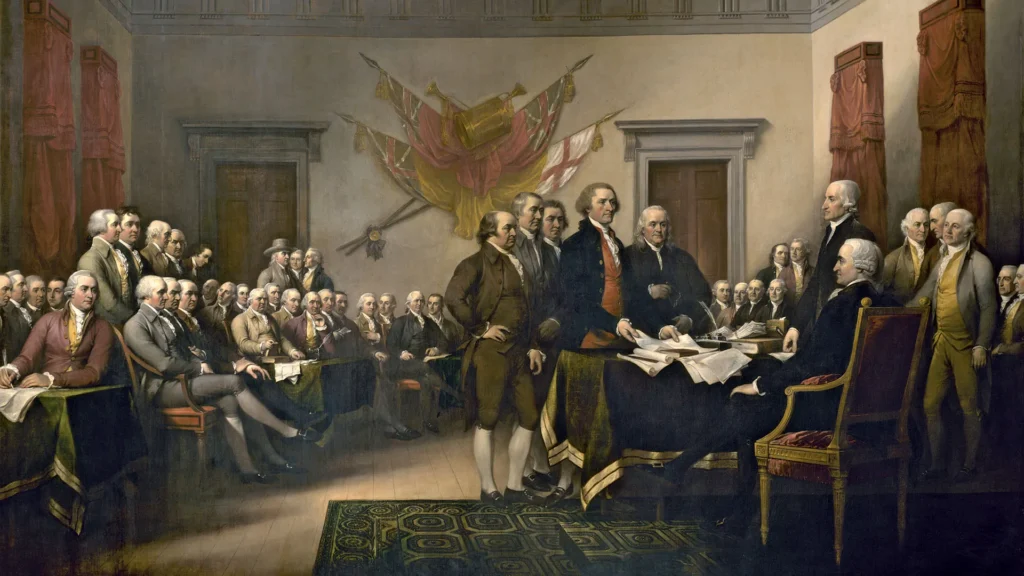
Painting by John Trumbull. Placed in U.S. Capitol rotunda, 1826
***
We are fast approaching America’s birthday, July 4th.
But it’s just not any ordinary birthday this year.
July 4, 2026 is the 250-year anniversary of the adoption of the Declaration of Independence by the Second Continental Congress in 1776, which formally asserted the 13 colonies’ independence from Great Britain.
To be more precise, the 250th anniversary of the United States is the semiquincentennial of the Declaration of Independence, which will be celebrated on July 4, 2026, with a year‑long slate of national events branded as “America 250” or “Freedom 250.”
Congress created the U.S. Semiquincentennial Commission to plan and coordinate national observances for the 250th anniversary.
Events scheduled for the big bash, July 4, 2026, will feature a military parade on the National Mall, fireworks, and large‑scale ceremonies in Washington, D.C., Philadelphia, and other historic sites, along with a multitude of other activities.
To many, America’s 250th birthday is more than patriotic parades with Uncle Sam hats, fireworks blazing through the sky, and firing up the grill for barbecues. Rather, the event represents a real opportunity for us as a nation to evaluate if our country has lived up to the principles laid out by our Founding Fathers in 1776, such as equality, limited and accountable government, separation of powers, and protection of individual rights.
For many, the Declaration of Independence, crafted so eloquently and powerfully by Thomas Jefferson didn’t live up to its core principles right from the beginning.
Historians point out that not long before Thomas Jefferson would write that “all men are created equal” in the foundational document adopted by the Second Continental Congress on July 4, 1776, he
signed a runaway advertisement in the Virginia Gazette (September 14, 1769), seeking the capture of a “mulatto slave” named Sandy and offering a reward for his return.
Of the more than 600 slaves Jefferson owned, he emancipated only five.
Historians are additionally quick to point out that 4 of the first 5 U.S. presidents were Virginians who enslaved people, with John Adams of Massachusetts representing the lone exception among them.
Further, to get a sense just how prevalent slave owners were in the early years of our fragile Republic, it’s worth noting that that 41 of the 56 signers of the Declaration of Independence—about three‑quarters—owned slaves at some point.
As we take a closer look at the Declaration of Independence, we are reminded, time, and again, that the Founders emphasized republican self-government, checks and balances among the branches, the rule of law, and protection of individual rights like free speech, due process, and religious liberty, among other attributes.
And yet, a June 2026 Quinnipiac University national poll reports that about 61 percent of Americans thinks the United States is not living up to the Declaration of Independence’s ideal that all people are created equal, while only 35 percent think it is.
The constitutional system created by Congress during the blistering hot summer of 1787 in Philadelphia, divided national power into three branches—legislative (Congress), executive (the president), and judicial (the courts)—so that no single center of authority could dominate. Such a system was designed to prevent tyranny, the kind of oppressive tyranny that King George III of Great Britain imposed on the 13 colonies.
Such a democratic system appears to have broken down under the Donald Trump administration.
A January, 2026 report issued by Amnesty International, shows a clear pattern of rising authoritarian practices and a “devastating erosion of human rights” one year into the Donald Trump’s second administration.
Still others argue that partisan polarization, gerrymandering, and voter suppression have produced a democracy that does not fairly represent all citizens; this along with a profound lack of trust that government derives its just powers from the consent of the governed.
Some of the founders, especially George Washington, warned against permanent foreign entanglements and large standing armies, preferring limited involvement abroad.
Despite the Founding Fathers hopes for the nation, the United States, according to Smithsonian magazine, has been at war in 93.5 % of the calendar years between 1775 and 2018.
The United States has been at war with Iran since February 28, 2026, when the U.S. and Israel launched coordinated strikes on targets in Tehran and multiple Iranian military sites after weeks of buildup.
Most alarming of all, the Founding Fathers, including John Adams, feared centralized power and corruption, stressing that government should serve the public good rather than “the profit, honor, or private interest of any one man, family, or class of men.”
Forbes magazine reported (September, 2025) that Trump’s estimated net worth leaped from about $3.9 billion in 2024 to $7.3 billion in 2025, a remarkable $3.4 billion increase within that year.
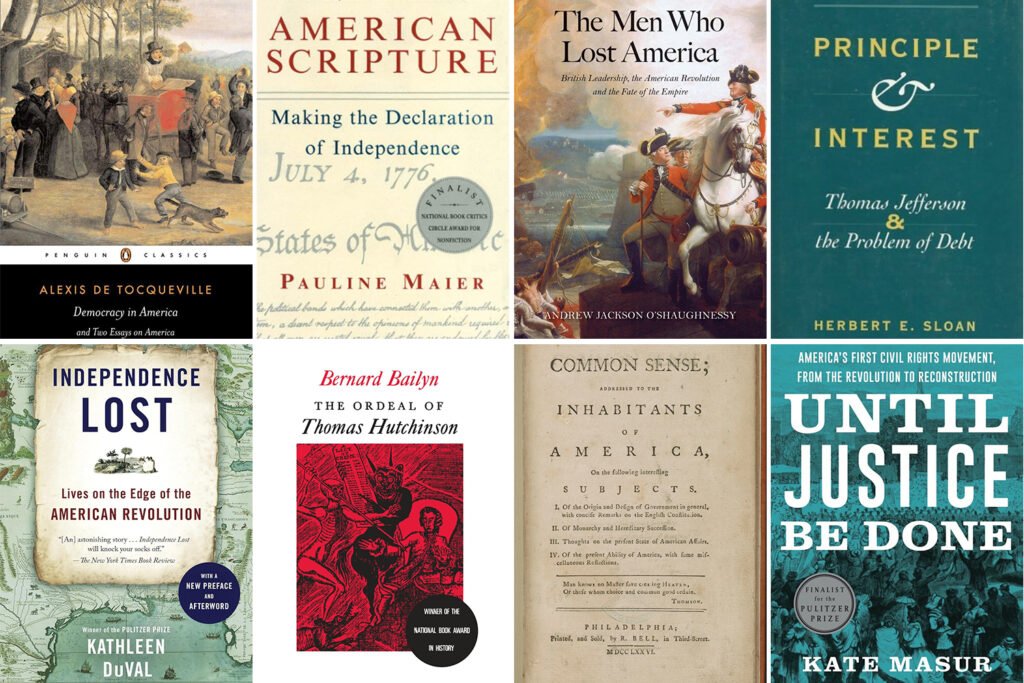
Since this year does mark the 250th year of the United States, I thought it would be interesting to ask some journalists, historians, and scholars, which books (including works of fiction), best captures the attributes, and spirit of the United States over the last 250 years?
What follows are their recommendations.
William Sturkey a historian of the United States at the University of Pennsylvania who specializes in the history of race in the American South since 1865, recommends:
• After Appomattox: Military Occupation and the Ends of War by Gregory P. Downs
Downs argues the American Civil War effectively continued as a U.S. military occupation of the South until about 1871, rather than ending neatly with Lee’s surrender in April 1865.
***
Richard R. John, professor of history and communications at Columbia University, recommends:
• Danielle Allen, Our Declaration: A Reading of the Declaration of Independence in Defense of Equality.
“Our Declaration” has been described as a close, philosophical reading of the Declaration that argues it is as much a manifesto for equality as it is a charter of liberty.
• Daniel Walker Howe: “What Hath God Wrought: The Transformation of America, 1815-1848 “
A book which describes the U.S. from the end of the War of 1812 through the Mexican–American War, with particular emphasis on communications/transport revolutions, evangelical religion, and the rise of mass politics.
• Achieving our Country by Richard Rorty
A short but major intervention in how the American Left understands its own history and future strategy, especially its relationship to patriotism, labor politics, and cultural criticism.
• AMERICAN DREAM P: A Short History of an Idea that Shaped a Nation by Jim Cullen
Cullen argues that the United States is unusual in defining itself around ideals—especially those in the Declaration of Independence—rather than ethnicity, religion, or geography, and that the “American Dream” is a flexible phrase that expresses those ideals across time.
***
Samuel Moyn, the Kent Professor of Law and History at Yale University recommends:
• Miss Lonelyhearts By Nathanael West
A short 1933 novel about a male newspaper advice columnist whose attempts to respond sincerely to desperate reader letters drive him toward psychological and spiritual collapse in Depression‑era New York
• The Time of Our Singing: A Novel by Richard Powers
This novel follows a mixed-race, musically gifted family across much of the 20th century, using music, race, and physics to explore identity and belonging in America.
***
Deborah Dash Moore, Professor of History and Judaic Studies at the University of Michigan, recommends:
• Black Reconstruction in America by W. E. B. Du Bois
Black people, Du Bois argues, especially the formerly enslaved, were central political actors whose collective actions—including the “general strike” of withdrawing labor from the Confederacy—helped win the war and reshape the South. The prevailing white supremacist historiography (“the propaganda of history”) deliberately erased Black testimony and blamed Black citizenship for Reconstruction’s problems
• A People’s History of the United States by Howard Zinn
A People’s History of the United States is Howard Zinn’s landmark 1980 history book that tells the story of the United States from the perspective of ordinary people—workers, enslaved people, women, immigrants, and other groups traditionally marginalized in standard textbooks. Zinn’s central premise is that conventional U.S. histories focus too much on presidents, generals, and economic elites, and too little on the people who experienced the consequences of their decisions.
• Indians in Unexpected Places (CultureAmerica) by Philip J. Deloria
This book examines how Native people’s everyday engagement with modernity—cars, sports, film, and music—disrupts entrenched stereotypes of “primitive” Indians frozen in the past.
• Out to Work: A History of Wage-Earning Women in the United States, 20th Anniversary Edition by Alice Kessler-Harris
This is a classic study of how women’s work in America evolved from unpaid domestic labor to wage labor and how that process reshaped both gender roles and the labor market. The book traces women’s wage-earning from colonial America through the late twentieth century, focusing on how social, economic, and ideological forces defined what counted as “women’s work.”
• Jewish New York: The Remarkable Story of a City and a People by Deborah Dash Moore
A narrative history of New York’s Jews over roughly 350 years, designed as a readable but scholarly “definitive” overview of how Jews helped shape the city and how the city shaped them in turn. The book traces Jewish presence from the earliest small community in New Amsterdam through 19th‑century mass immigration, the Lower East Side era, and into late‑20th‑century suburbanization and Soviet Jewish arrivals.
***
Michael Rossi, Associate Professor of the History of Medicine and the College, at the University of Chicago, recommends:
• Moby Dick by Herman Melville
A classic piece of literature about Captain Ahab’s obsessive, self‑destructive hunt for a legendary white sperm whale, as narrated by the sailor Ishmael. The crew’s struggle against the sea and the whale raises questions about whether humans can control or understand the forces that govern their lives. The novel is packed with biblical allusions, meditations on free will and predestination, and reflections on good, evil, and the unknown.
***
David Greenberg, Professor of History and Journalism & Media Studies at Rutgers University, recommends:
• The Adventures of Augie March by Saul Bellow
A 1953 picaresque novel about a poor Jewish boy from Chicago whose restless, free‑style journey through Depression‑era America became one of the touchstone candidates for the “Great American Novel.” The novel follows Augie March, a fatherless, largely parentless kid growing up on Chicago’s West Side in the years around the Great Depression.
• Invisible Man by Ralph Ellison
A 1952 novel about an unnamed Black narrator whose search for identity in racist mid‑century America leads him to conclude that society renders him “invisible” because it refuses to truly see him as a person.
• American Pastoral: American Trilogy 1 by Philip Roth
A 1997 novel about Seymour “Swede” Levov, a seemingly ideal postwar American success story whose life is shattered when his daughter becomes a violent radical in the 1960s. It is the first book in Roth’s “American Trilogy” and won the Pulitzer Prize for Fiction. Major themes include the fragility of the American Dream, the gap between public ideals and private realities, and the violent upheavals of the 1960s.
• The Genius of American Politics (Walgreen Foundation Lectures) by Daniel J. Boorstin
Boorstin argues that American politics grew out of habits, institutions, and religious-cultural experience more than from abstract doctrines, which is why the U.S. has produced few “grand theories” compared with Europe.
• People of Plenty: Economic Abundance and the American Character by David M. Potter
A classic 1954 study, arguing that the defining feature of the United States is not ideology or political genius, but long‑term economic abundance and its effects on national character. He argues that the broad availability of land, resources, and economic opportunity deeply shaped Americans’ attitudes toward democracy, equality, mobility, and their sense of a national mission.
• The Good Citizen: A History of American CIVIC Life by Michael Schudson
A historical study of how Americans have defined and practiced “good citizenship” from the 18th century to the late 20th century, arguing that civic life has moved through several distinct eras rather than simply declining over time. Schudson’s key claim is that you cannot judge citizenship simply by whether people vote or read political news, because the definition of good citizenship has changed over time.
• Republic of Spin: An Inside History of the American Presidency by David Greenberg
This is a narrative history of how presidents from Theodore Roosevelt through Barack Obama built and refined the modern “spin” machine around the White House. Greenberg traces presidential “spin” from the early 1900s to the Obama era, treating image-making as a central part of modern presidential power rather than a sideshow.
• The Story of American Freedom by Eric Foner
A sweeping interpretive history of the United States that traces how Americans have defined, fought over, expanded, and restricted “freedom” from the Revolution through the late 20th century. Foner argues that the United States has fought wars “for freedom” (Civil War, World War II, Cold War) while different groups have experienced freedom very unequally at home.
***
Matthew Jacobson, a Sterling Professor of American Studies and History at Yale University, author of eight books on race, politics, and culture in the United States, recommends:
• This Land is Your Land: A Road Trip Through U.S. History by Beverly Gage
A 2026 narrative history–meets–travelogue that uses visits to historic sites around the country to tell 250 years of American history through 13 key places and moments.
• A New Literary History of America by Greil Marcus (Editor) and Werner Sollors (Editor)
A 1,000‑page anthology of about 200 short essays that uses “literary history” as a way to tell a sprawling cultural history of the United States from the 1500s to the present. Marcus and Sollors frame America as a “made‑up nation” whose identity is continually invented in words, images, and performances, so literary history becomes a story of how the country imagines itself.
***
Theresa Runstedtler, a scholar of African-American history at American University-whose research examines Black popular culture, with a particular focus on the intersection of race, gender, labor, and sport, recommends:
• Impossible Subjects: Illegal Aliens and the Making of Modern America – Updated Edition (Politics and Society in Modern America) by Mae M. Ngai
Ngai traces how the modern U.S. category of the “illegal alien” emerged from restrictive immigration laws, especially between the 1924 Johnson‑Reed Act and the 1965 Hart‑Celler Act. She argues that these legal regimes not only controlled entry but also constructed racialized hierarchies of belonging, producing groups that were present in American society yet rendered “impossible” in law.
• Negroes with Guns by Robert F. Williams (Author), Martin Luther King (Author), Truman Nelson (Author)
Negroes with Guns is a 1962 book by civil rights activist Robert F. Williams, based on his experiences as NAACP leader in Monroe, North Carolina, and his advocacy of armed Black self‑defense against Klan and white supremacist violence. The narrative describes how Black residents in Monroe organized armed protection amid repeated attacks and official tolerance of racist violence, bringing the question of armed self‑defense into the heart of the civil rights debate. The book became a foundational text for later Black Power and Black Panther thinking, especially around the legitimacy of armed self‑defense when state protection fails.
***
Louis P. Masur, Professor of American Studies and History at Rutgers University, recommends:
• The Sum of Our Dreams: A Concise History of America by Louis P. Masur
This is a single‑volume narrative history of the United States, from the colonial era through the Trump years, organized around the evolving “American dream” of freedom, equality, and opportunity. Masur moves chronologically from the colonies and Revolution through the Early Republic, Civil War, Reconstruction, Gilded Age, Progressive Era, World Wars, Cold War, Civil Rights, Vietnam, Watergate, and into the last four decades up through the Trump administration.
• Walt Whitman’s Leaves of Grass (150th Anniversary Edition) by Walt Whitman
Whitman uses long, free‑flowing lines, catalogs, and direct address to celebrate the self, the body, democracy, sexuality, labor, and the American landscape.
This 150th Anniversary Edition reproduces the typeface, design, and layout of the first 1855 edition that Whitman himself supervised, giving readers what is essentially the “ur-text” of Leaves of Grass before his later expansions and revisions.
• Common Sense, The Rights of Man, and Other Essential Writings of Thomas Paine by Thomas Paine
The complete text of “Common Sense” (1776), Paine’s incendiary pamphlet urging American independence from Britain.
***
Max Paul Friedman, Professor of International Relations at American University, who specializes in 20th-century U.S. foreign relations, recommends:
• Independence Day: Bascombe Trilogy 2 by Richard Ford
“Independence Day” was first published in 1995 as the sequel to Ford’s 1986 novel “The Sportswriter.” The novel follows Frank Bascombe through the Independence Day weekend as he visits his ex-wife, his troubled teenage son, his girlfriend, tenants, and real-estate clients.The book is often described as a “visionary account of American life,” using the late-1980s financial and housing downturn as a backdrop for middle-aged disillusionment and the search for a workable version of “independence.”
• Borderlands/La Frontera: The New Mestiza, Fourth Edition by Gloria Anzaldua
A landmark hybrid of essay and poetry that theorizes the U.S.–Mexico borderlands as a physical, cultural, linguistic, sexual, and spiritual space of conflict and creative possibility. Anzaldúa redefines the border not only as a geopolitical line between the U.S. and Mexico but as a “psychic, social, and cultural terrain” that people inhabit through race, gender, sexuality, language, and class.
• Liberty Is Sweet: The Hidden History of the American Revolution by Woody Holton
A large-scale, revisionist history of the Revolution that centers enslaved people, Native Americans, women, and other marginalized groups as active shapers of the struggle for independence, not just background figures to the Founders. Holton argues that the Revolution cannot be understood solely through elite Patriot leaders; instead, it emerged from the pressures and initiatives of groups often left at the margins of traditional narratives.
• The Souls of Black Folk by W.E.B. Du Bois
A collection of essays (1903) that analyzes Black life, racism, and democracy in the post–Civil War United States and introduces his famous ideas of the “color line,” “the veil,” and “double-consciousness.”
***
John Carson, associate professor of history at the University of Michigan, recommends:
• The Origins of the Urban Crisis: Race and Inequality in Postwar Detroit by Thomas J. Sugrue
Sugrue argues that Detroit’s decline and the broader “urban crisis” were rooted in pre‑1960s structures of racism, housing segregation, and deindustrialization, not just the turmoil of the 1960s. He shows how workplace discrimination, public policy, and capital flight created durable racialized inequality in a city once hailed as the “arsenal of democracy.”
• The Rediscovery of America: Native Peoples and the Unmaking of U.S. History by Ned Blackhawk
A 2023 National Book Award–winning reinterpretation of U.S. history that puts Indigenous nations at the center of the story from first contact through the late 20th century. Blackhawk’s core claim is that you literally cannot understand the United States—its politics, economy, and culture—without understanding its Indigenous history. He insists that Native nations were central to every century of U.S. development, not peripheral actors who “disappear” after colonization.
• The Rise and Fall of the Second American Republic: Reconstruction, 1860-1920 by Manisha Sinha
A sweeping reinterpretation of Reconstruction that treats the Civil War and its aftermath as a “second American republic” built on abolitionist, interracial democracy—and then traces how that democratic revolution was slowly unwound by white supremacy, industrial capitalism, and imperial expansion through 1920. She contends that Reconstruction did not simply “fail” in 1877; instead, it experienced a short-lived triumph followed by a long, uneven unwinding as white supremacist violence, disfranchisement, and a changing Republican Party agenda dismantled interracial democracy over several decades.
• To Kill a Mockingbird by Harper Lee
“To Kill a Mockingbird” is a 1960 novel by Harper Lee that follows young Scout Finch as she comes of age in the racially segregated town of Maycomb, Alabama, while her father Atticus defends a Black man falsely accused of raping a white woman. It is widely regarded as a modern classic of American literature, known for its portrayal of racism, moral courage, and childhood innocence. The trial shows how racial prejudice overrides evidence and law, making justice unattainable for Tom Robinson
• Catch-22: 50th Anniversary Edition by Joseph Heller
In the novel, “Catch‑22” is a military rule that creates a no‑win situation. The key version: if a pilot keeps flying dangerous missions, he must be crazy and in theory can be grounded, but if he requests to be grounded, that proves he is sane and therefore must continue flying. That circular logic becomes the book’s metaphor for modern bureaucracy and systems that are formally rational but practically insane.
• The Jungle by Upton Sinclair
A 1906 novel that exposes brutal working and living conditions for immigrant laborers in Chicago’s meatpacking industry and helped spur major U.S. food safety laws. Sinclair’s primary goal was to expose the exploitation of immigrant workers under early 20th‑century industrial capitalism, emphasizing wage slavery, unsafe factories, corrupt politics, and the crushing of the “American Dream.
• Another Country (Vintage International) by James Baldwin
A 1962 novel about a circle of Black and white friends, straight and queer, in New York and France, whose intertwined love affairs and betrayals force them to confront race, sexuality, and emotional violence. Known for its then-shocking frankness about interracial relationships and bisexuality, and often cited as one of Baldwin’s major, boundary‑pushing novels.
***
Vincent Brown, the Charles Warren Professor of American History and Professor of African and African American Studies at Harvard University, recommends:
• A Resistance History of the United States by Tad Stoermer
A 2026 narrative history that traces American history through episodes of organized resistance to abusive power, from the 1600s to the modern era, and uses those case studies as a practical playbook for how resistance actually works. Stoermer contends that the American Revolution did not secure liberty for everyone but instead opened a contested space where white male citizens monopolized most rights and protections, forcing other groups to resist to claim their share.
***
Fredrik Logevall, the Laurence D. Belfer Professor of International Affairs at the John F. Kennedy School of Government and Professor of History, Harvard University, recommends:
• A Life in the 20th Century: Innocent Beginnings, 1917-1950 by Arthur Meier Schlesinger
This is the first volume of Schlesinger’s memoirs, covering his life from birth through the early Cold War and the publication of The Vital Center and The Age of Jackson. Schlesinger frames his personal story as “a life in the twentieth century,” using his experiences to illuminate interwar America, the New Deal, World War II, and the early Cold War from an insider-liberal perspective.
• The Ideological Origins of the American Revolution by Bernard Bailyn
A landmark 1967 study arguing that the Revolution was driven by a coherent, deeply held political ideology centered on liberty, power, and suspicion of corruption, rather than mainly by material or narrow economic grievances. Bailyn’s core claim is that Revolutionary leaders and pamphleteers shared a coherent “language of politics” that emphasized the dangers of tyranny, corruption, and conspiracies against liberty.
• The American Political Tradition: And the Men Who Made it by Richard Hofstadter
A landmark 1948 work of U.S. political history in which Hofstadter analyzes major American leaders from the Founders through FDR to argue that, beneath surface conflicts, they largely shared a common capitalist, individualist ideological core. Hofstadter claims that despite intense partisan clashes, American political leaders have “shared a belief in the rights of property,” economic individualism, competition, and the virtues of capitalist culture as basic traits of human nature.
***
Some of the books, I personally think best captures the essential qualities, attributes, and spirit of the United States over the last 250 years, include:
• The Great Gatsby by F. Scott Fitzgerald
A masterpiece and one of the defining works of the Jazz Age. The novel explores the fragility of the “American Dream,” showing how the pursuit of wealth and status can corrupt ideals and lead to disillusionment
• The Grapes of Wrath by John Steinbeck
A Great Depression–era novel following the Joad family, Oklahoma sharecroppers driven off their land who migrate to California and confront exploitation, poverty, and the struggle for dignity.
• Beloved by Toni Morrison
A 1987 novel about an escaped enslaved woman, Sethe, whose Ohio home is haunted by the ghost – and later the uncanny bodily return – of the baby daughter she killed rather than see re‑enslaved. The book explores the psychological and generational trauma of slavery, the limits of maternal love, and the struggle to claim a free self in the aftermath of dehumanization.
• These Truths: A History of the United States by Jill Lepore
A sweeping one‑volume narrative of American history, structured around the founding ideals of political equality, natural rights, and popular sovereignty, and how the U.S. has lived up to—or failed—those ideals from 1492 to the near‑present.
• Democracy in America by Alexis de Tocqueville
Alexis de Tocqueville’s two‑volume analysis of the United States’ political and social order in the 1830s, famous for its insights on equality, liberty, and the strengths and dangers of modern democracy. One of Tocqueville’s most cited concepts is “tyranny of the majority.” He worries that in a democracy, the majority’s opinion can become so dominant that it suppresses dissenting voices, not just through law but through social pressure.
• The Idea of America: Reflections on the Birth of the United States by Gordon S. Wood
First published in 2011, The Idea of America is a collection of eleven essays on the political thought, culture, and long‑term meaning of the American Revolution, written over several decades and revised with new postscripts. Wood treats the Revolution as the central event in American history, “bar none,” because it created the basic ideological framework within which later conflicts (Civil War, Progressivism, civil rights) unfolded.
–Bill Lucey
June 25, 2026
WPLucey@gmail.com
250th Anniversary Resources
• Celebrating 250 Years of American History (U.S. Department of State)
• U.S. History Primary Source Timeline (Important topics and moments in U.S. history through historical primary sources from the Library of Congress)
• Milestone Documents (The primary source documents on this page highlight pivotal moments in the course of American history or government).
Leave a Reply